

Enterprise AI’s biggest challenge isn’t better models — it’s deterministic control.
By Sunil Grover, Managing Partner, G2C Ventures
Cosimo’s article makes the case clearly: LLMs, RAG, and semantic caching improve generation, grounding, and speed, but they remain probabilistic and “ill-conditioned.” Small changes in prompts, context, or permissions can create dramatically different outcomes — unacceptable for mission-critical workflows.
Enterprises don’t just need AI memory — they need permissioned memory
The real question isn’t whether an answer looks similar. It’s whether it is still authorized, tenant-safe, compliant, and auditable right now.
And this governance cannot be bolted on later with security or compliance tools. It has to be embedded directly into the architecture and runtime fabric of the AI system itself.
Models alone won’t solve enterprise workflow automation. Deterministic control layers will.
“Similarity finds plausible answers; provenance proves reusable answers.”
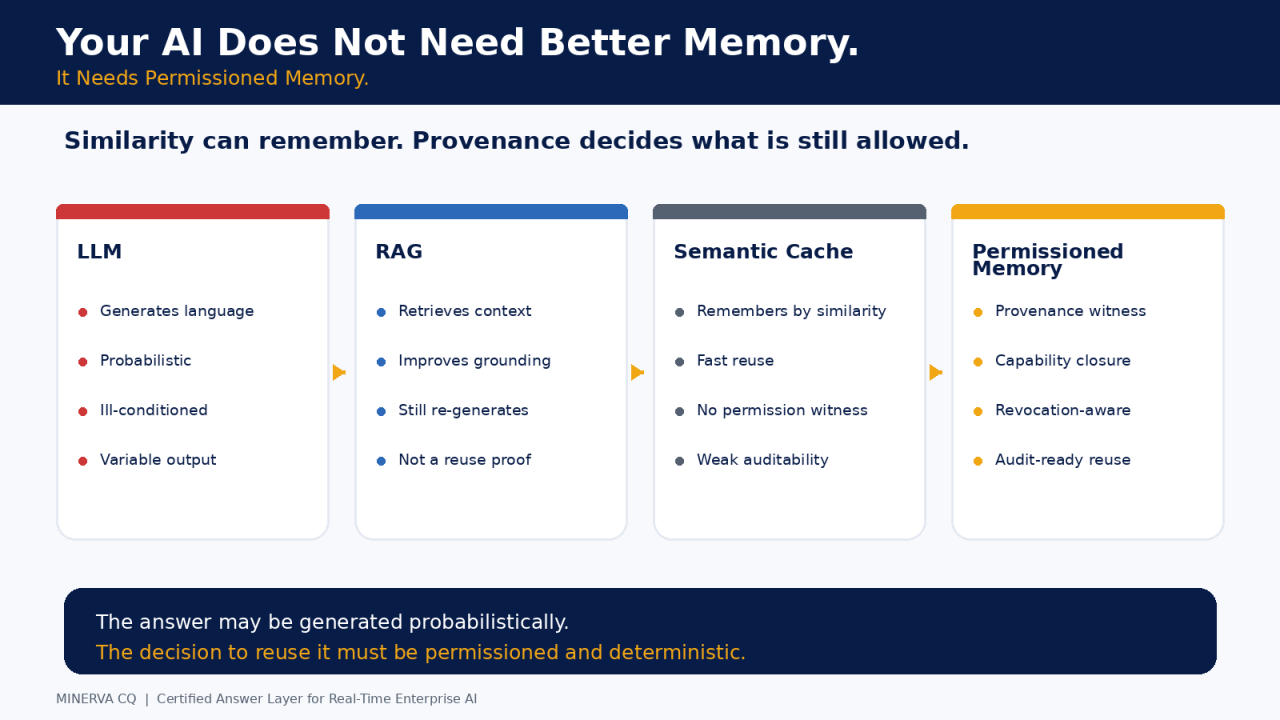
Your AI Does Not Need Better Memory. It Needs Permissioned Memory.
LLMs generate. RAG retrieves. Semantic caches remember. But enterprise AI needs something more important: it needs to know what is still allowed.
Large language models are probabilistic by design. That is not a defect; it is part of what makes them powerful. They can interpret ambiguous language, summarize messy conversations, generate useful responses, and adapt to context in ways traditional software could not. RAG made this more useful for the enterprise by grounding generation in retrieved knowledge. That was an important step. But it did not solve the next problem.
Enterprise AI systems are now moving from one-off answers to continuous conversations, agentic workflows, and reusable AI memory. That creates a different question. Not only: can the AI answer? But: can this answer be reused now?
That is where many current architectures become fragile. LLM-based systems are often ill-conditioned. In mathematics, an ill-conditioned system is one where a small change in the input can produce a large change in the output. Enterprise LLM systems behave this way operationally. A small change in prompt wording, retrieved context, policy language, conversation history, or tool availability can alter the answer, change the reasoning path, shift the recommendation, or change what the model decides to do next.
This is why two apparently similar conversations can produce different answers. It is also why two apparently similar answers can have very different safety implications. The problem is not simply that LLMs are probabilistic. The problem is that enterprise AI systems often place probabilistic and ill-conditioned components inside workflows that require deterministic behavior.
A bank cannot have probabilistic permission. An insurance company cannot have probabilistic compliance. A telecom operator cannot have probabilistic customer eligibility. A BPO serving multiple clients cannot have probabilistic tenant isolation. A public-sector agency cannot have probabilistic auditability.
In enterprise AI, some decisions must be deterministic. Was this customer authenticated? Was this tool authorized? Was this policy active? Was this answer generated under the right permission context? Can this answer be reused now? Can we prove why it was reused?
These are not questions that should be answered by the LLM. They are not questions that RAG alone can answer. And they are not questions that should be delegated to semantic similarity. They are control-layer questions.
RAG improves grounding. LLMs improve language generation. Semantic caches improve speed. But none of them, by themselves, answer the enterprise control question: is this answer still authorized, still valid, still tenant-safe, and still auditable at the moment of reuse?
Traditional RAG systems often generate answers repeatedly. They can be slow, expensive, inconsistent, and difficult to audit. Semantic caches improve speed by reusing answers when a new question looks similar to a previous one. But similarity is not authorization.
Two questions can look almost identical and require different permissions. Two answers can be textually identical and still be safe in one context and unsafe in another. An answer generated for Client A must not be served to Client B because the embeddings are close. A billing answer generated when a customer was authenticated must not be reused after the permission state changes. A policy explanation valid yesterday must not continue to be served after the policy has been withdrawn.
This is the enterprise AI reuse problem. Retrieval finds relevant context. Generation produces a response. Reuse decides whether a previous answer is still allowed. That third decision cannot be left to semantic similarity. It requires deterministic control around probabilistic and ill-conditioned generation.
At Minerva CQ, this is the principle behind our Certified Answer Layer. We do not treat a reusable answer as just text. We treat it as an enterprise asset that must carry its provenance. Every reusable answer should know what justified it: which facts were used, which permissions were active, which capabilities were required, which policy context applied, which customer or tenant boundary constrained it, and what certificate made it safe to reuse.
Then, when a similar question appears, the system does not simply ask whether the answer looks close enough. It asks whether the provenance still holds. If the witness is still contained in the current permission and capability closure, the answer can be reused. If not, it is blocked, regenerated, or recertified.
That is the shift from semantic caching to permissioned memory. A semantic cache says: “This looks similar.” Permissioned memory says: “This is still allowed.” That distinction is the difference between speed and governed speed. It is also the difference between AI memory and AI liability.
The future of enterprise AI is not about replacing LLMs. It is not about replacing RAG. It is about adding the deterministic control layer they need for production. The model can remain probabilistic. The retrieval layer can remain adaptive. The model may remain ill-conditioned. But the system deciding whether an answer may be reused, acted upon, or audited must not be. That layer must be deterministic.
This is especially important in contact centers, BPOs, telecom, insurance, banking, utilities, healthcare operations, and public-sector services. These environments do not just need faster answers. They need answers that are consistent, authorized, traceable, and safe to reuse.
That is why permissioned memory matters. It turns verified answers into reusable enterprise assets without losing governance. It reduces unnecessary generation. It improves consistency. It lowers latency. It creates an audit trail. And it prevents one of the most dangerous failure modes of enterprise AI memory: reusing the right-looking answer in the wrong context.
At Minerva CQ, our view is simple: similarity finds plausible answers; provenance proves reusable answers.
Enterprise AI does not become trustworthy by pretending the model is deterministic. It becomes trustworthy by surrounding probabilistic and ill-conditioned models with deterministic control. Ill-conditioned models require well-conditioned control layers.
That is how enterprise AI moves from impressive demos to safe production. That is how AI memory becomes auditable. And that is how real-time AI systems become reliable enough for regulated enterprise deployment.