
What the Next Generation of Enterprise AI Builders are Getting Right
By Sunil Grover, Managing Partner, G2C Ventures
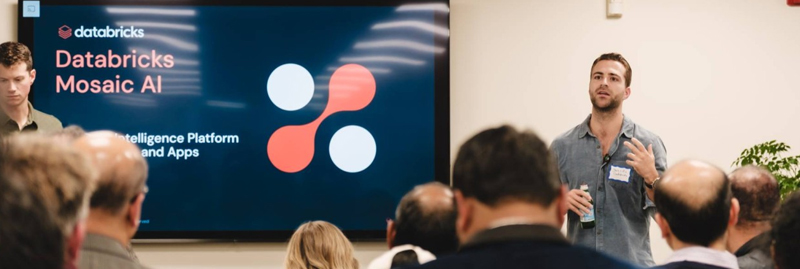
Last week in Palo Alto, we co-hosted Data + AI Advantage with our partners at Databricks. The room was full—standing room only, with a long waitlist—and that alone told us something important: despite all the noise around AI, the builders and operators who are actually deploying AI in the enterprise are hungry for deeper, more practical conversations.
At G2C Ventures, we spend our time at the earliest stages of company building, working with founders who are turning cutting-edge technology into durable, category-defining businesses. What stood out to me at this event wasn’t just the energy—it was the clarity. Enterprise AI is moving decisively from experimentation to production, and a new generation of founders and platform leaders is getting some critical things right.
Who Was in the Room—and Why It Mattered
The audience composition was intentional and telling.
Roughly half the room consisted of GenAI-native founders—deeply technical builders designing systems from first principles, not retrofitting AI onto legacy architectures. The other half were Director+ and C-level executives from independent software companies ($10–$200M ARR), the people actively shaping data and AI roadmaps inside real enterprises.
That mix matters. When GenAI native builders and established leaders are learning together, the conversation shifts from hype to signal. You could feel it in the questions, the hallway conversations, and the debates that continued long after the sessions ended. This is what a healthy enterprise AI ecosystem looks like.
Here are my key takeaways from the event
Key Takeaways: What’s Actually Working in Enterprise AI
Rather than recap individual exchanges, I’ll share a few patterns that consistently surfaced across founders, operators, and platform leaders.
First, the market is moving past pilots. Enterprises are no longer impressed by demos alone. They want production-grade systems that integrate deeply with their existing data, workflows, and security models. The question has shifted from “Can this work?” to “How can this run my business?”
Second, agentic workflows are emerging as the real unlock. We’re seeing a clear evolution from copilots/team-mates and isolated AI features toward autonomous, agent-driven workflows that span functions—sales, finance, operations, compliance. These systems don’t just generate insights; they take action, orchestrating complex processes across the enterprise.
Third, data quality, reliability and architecture are the bottleneck—and the opportunity. The most successful teams are those grounding AI in trusted, well-governed data. Without that foundation, even the best models fail to deliver lasting value. These worklows are semi-autonomous (much like the Tesla FSD 🙂 humans are to supervise the results today and take over when performance moves to the edges of the guardrails. Thinking through the entire solution architecture is the opportunity as illustrated by Arvind Jain ‘s recent post
Agentic Workflows the Next Frontier
Founders are actively designing systems where AI agents orchestrate complex workflows—across data sources, models, and tools—while operating within enterprise security boundaries.
The most compelling examples weren’t about a single large language model. They were about systems:
- Multiple models working for different workflows or portions of the workflow
- Tight integration with enterprise data
- Clear human-in-the-loop controls
- Production-grade reliability and security
This shift requires more than clever prompts. It requires a foundation that was built for scale from day one.
Why Platforms and their Ecosystems Matter More Than Ever
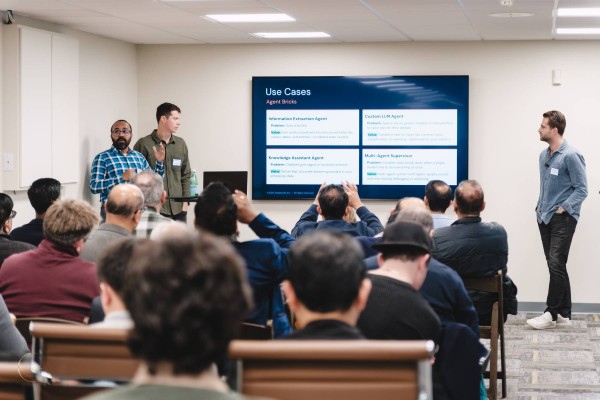
Use cases on how platforms shortern the time to market for data/Agents/Security elements
A recurring insight from the event was that AI platform choice is now a strategic decision, not a technical one.
Platform choices have always been a strategic decision for new builds during technology shifts. The choices have ranged from MS Dos vs. Apple, .Net vs. Java, SAP vs. Oracle, Android vs. Apple’s iOS, AWS vs. GCP vs. Azure and so on. Eventually, to emerge as a category leading ISV you have to be omnipresent, but where you start can decide the initial time to market advantage you can leverage.
As AI becomes embedded into core business processes, startups need infrastructure that supports:
- Secure access to vast data reserves
- Multi-model orchestration (LLMs and SLMs)
- Turn massive data reserves into real business outcomes
- Security, governance and observability to operate behind enterprise boudaries
- Enterprise-grade tech stack from day one even though usability cycles may be with SMBs
In the discussion that followed, it was clear why platforms like Databricks s play such a critical role. The lakehouse architecture and the Unity Catalog is enabling teams to move faster without cutting corners—turning data into a durable competitive advantage rather than a bottleneck.
Equally important is the ecosystem around the platform: partners, operators, and investors who understand both the technology and the enterprise context. In the Q&A that followed it was clear how the ecosystem around the platform is a key differentiator. Enterprise buyers need a tech stack with a vibrant ecosystem to upgrade end-to-end business operations to extract value.
How G2C Thinks About Building Enduring Enterprise AI Companies
At G2C Ventures, we describe ourselves as company-building investors. Having been founders turned investors with multiple victory laps, Capital is necessary but it’s never sufficient. What excites us most is seeing technical depth paired with unique domain insights and execution discipline.
At G2C Ventures, we are looking to work with founders who are:
- Deeply technical and domain-experts
- Obsessed with real customer problems
- Willing to build patiently, not just quickly
We invest early and stay close—helping founders refine product-market fit, design scalable go-to-market motions, and build companies that can grow into $100M+ ARR businesses over compressed timelines.
Events like this reinforce why community and ecosystems are central to this approach. When founders, operators, and platform leaders come together, the learning compounds—and the quality of companies that emerge improves dramatically. It brings into focus that the race is not about prompt optimizations for latest model releases; its about creating durable businesses with repeatable customer journeys that compound value over time.
From Insight to Action: Supporting Founders Early
Our support for founders starts early and stays hands-on.
Through our fellowship and incubation efforts, we back GenAI-native entrepreneurs with initial capital—often $50–100k—to help iterate toward product-market fit. As conviction builds, we typically invest $300–500k, co-leading or participating alongside strong institutional partners at the pre-seed, seed, or Series A stage.
This approach is informed by experience. Before becoming an investor, I was a founder and CEO, bootstrapping B2B SaaS companies to successful exits and scaling operations across the US, India, and APAC. At G2C, together with my co-managing partners Vik Ghai and Amar Chokawala, we’ve built and backed businesses from zero to $10M+ ARR and then scaled them well beyond that as part of larger platforms.
That operator DNA shapes how we work with founders today.
Looking Ahead: The Next Phase of Enterprise AI
If there was one clear message from the event, it’s this: enterprise AI is entering its execution phase.
Over the next few quarters and years, we’ll see:
- Agentic workflows move into the mainstream and innovation move to orchestration layer and AI helping optimize data-driven decision making
- Platforms converge with best-in-class LLMs
- Enterprises shift from copilots to autonomous systems running core processes
This creates a generational opportunity for founders who can combine technical depth, domain insight, and the discipline to build for production from day one.
Closing: Building the Ecosystem Together
We’re grateful to the founders, operators, and partners who joined us in Palo Alto—and especially to the Databricks team for co-hosting a conversation that went beyond surface-level trends.
At G2C Ventures, we believe the next generation of enduring enterprise AI companies will not be built in isolation. They will be built through close collaboration between exceptional founders, forward-thinking enterprise leaders, and long-term capital partners who understand both technology and business transformation.
As we continue building this ecosystem, we’re actively looking to engage with:
- Investors who share our conviction in early-stage enterprise AI and want to participate in building transformative companies, and
- Enterprise executives and operators who are shaping AI adoption inside their organizations and want to work closely with founders pushing the frontier of data- and AI-driven systems.
If you’re interested in starting a conversation about how you might get involved—as an investor, design partner, advisor, or ecosystem collaborator—I encourage you to reach out. Simply email circle@g2cventures.com These dialogues are how we collectively shape what comes next.
You can also follow Databricks for Startups and follow G2C Ventures to stay connected as we continue convening and building alongside the leaders defining the future of enterprise AI.
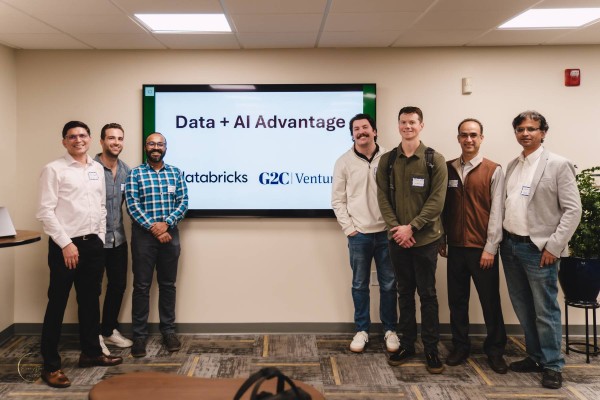
Pankaj Manglik Rohit Khanna Waheed Qureshi Rahul Sachdev Pratiti Raychoudhury Vijay Parmar Amar Chokhawala Vik Ghai